Showing posts with label Knitting. Show all posts

Tuesday, November 27, 2012

My First Charted Knitting Project

I used a charted pattern for the first time this past summer. It’s named The Alberta Seamen’s Scarf, and it’s from Stahman's Shawls & Scarves, by Myrna A. I. Stahman.
I used some alpaca yarn that I purchased at a local fiber festival (ahem) some time ago.

This scarf required two skills that were new to me: 1) a provisional cast on and 2) working with a charted pattern. Both took a few tries, but I am persistent – and I really really really wanted to have those skills. I was tempted to write out the pattern but decided against it. I’ve done that before, which is exactly the reason I still didn’t know how to read a chart.

Tutorials for a provisional cast on are plentiful. But for me, sometimes it's easier to quickly glance at a web page and think, "That's too complicated for me" and click away. This time, I followed the instructions in the book. By the way, a provisional cast on is one in which stitches are cast on with "waste yarn" (preferably a smooth yarn about the same weight/thickness as the one used for the project); it's used for many reasons (to write about another day, perhaps), one of which is when you are using a one-way pattern and want both ends or "tails" of a scarf to match. 

There is a very nice history to the seamen’s scarf.

Since 1898, during the Spanish American War, volunteers of the Seamen’s Church Institute have knitted, collected, packed, and distributed gifts to mariners who are miles away from home during the holidays. The gift consists of a handknit garment, a personal letter, and information on SCI’s services for mariners. In addition to this, SCI also includes several useful items like hand lotion, lip balm, and toothbrushes—things difficult to come by when working long stretches on the water.

Knitting groups around the country connect with SCI in weekly knitting meetings at churches and at knitting-sponsored events. Through online sites like Ravelry and the CAS blog, the Institute works with hundreds to make the program effective.

The historic name of this volunteer program, Christmas at Sea, only partially describes the work of the people who make holidays a little warmer for mariners. While gift distribution happens during winter months, collection and creation of items happens year round, and while many gifts go to international mariners working "at sea," thousands of gifts also go to mariners working on inland waterways here in the United States.

The Christmas-at-Sea Program of the Seamen's Church Institute of New York and New Jersey provides volunteer knitters with patterns for knitting scarves, watch caps, sweaters, and socks. -- Seamen’s Church Institute

Christmas at Sea that’s a Seamen’s scarf he is wearing
Christmas at Sea patterns free knitting patterns available


The traditional Seamen’s scarf is knit from end to end by knitting 14 inches of garter stitch [knit every row], followed by 18 inches of knit four, purl four ribbing, followed by another 14 inches of garter stitch. The garter stitch tails provide warmth to the chest of the wearer, and the knit four, purl four ribbing provides both a wonderful fit and warmth as it hugs the neck of the wearer. – Myrna Stahman, Stahman's Shawls & Scarves, page 4.

I have made many of these scarves for our local City Mission. We love gifts of warmth here in western New York! I have also used the pattern to make a few for my favorite guys. My husband lets me borrow his all the time. That is, until now. Because now I have my very own hand-knit Seamen’s scarf!

Here it is, drying after blocking.
Here's a close up of the left "tail" drying.
This is the center ribbed section.
On my lovely styrofoam head and box
See how it cozies up around the neck?

I've already started my next charted knitting project. Someday it will look like this (but in a different colorway):
It's called From Dawn Till Dusk and is designed by Tetiana Otruta. This pattern is a free download for Ravelry members. Ravelry is free to join, and is a treasure of resources, help, and fun. I think that there are now more than one million members, so if you're a knitter, head on over. On Ravelry, I'm DearKnitter.

Blessings and peace...

Thursday, November 15, 2012

Baby Surprise Jacket Sweater

I have knitted a lot of baby items, but seldom took photos of them. (Note: If you receive a handmade gift for your baby, it would be really nice and much appreciated if you were to send a photo of your baby wearing/using it to the person who made it. The knitter might have been weaving in the last ends in the car on her way to the baby shower.)

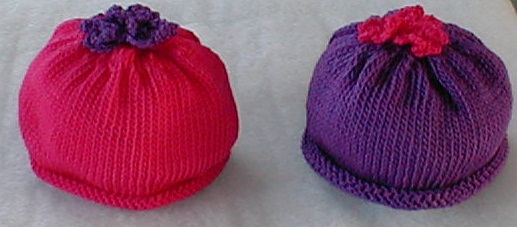
I showed you some hats for premature babies I knit one Lent:
Today I am remembering the Baby Surprise Jacket (BSJ), also known as the Baby Surprise Sweater. I lost count of how many of these I knitted. Plymouth Encore, a machine washable and machine dryable worsted weight yarn that is 75% acrylic and 25% wool, comes in solid and variegated colorways. (Why do some designers create patterns for cashmere garments for real live babies?)
So, about this BSJ sweater. It was designed by Elizabeth Zimmermann many years ago, and the pattern as well as a DVD that provides instructions for the sweater as well as many variations are available from her daughter's shop, Schoolhouse Press. It is knit all in one piece, and for a while, you wonder how you went so terribly wrong. Here's how it looks after it's knit but not sewn up:
And then when sewn up:
Oh and for this one I made a matching cap:

And here is one more:
And that same sweater on a friend's baby (Thanks, Kitty, for sending me the photo):

As Elizabeth Zimmermann wrote,
"Knit on, with confidence and hope, through all crises."


Blessings and peace...

Tuesday, November 6, 2012

Sewing the Easiest Ever Lined Drawstring Bag

Recently, Madeline (age 6) asked me to teach her how to knit. That will be so much fun! We'll probably start over her Christmas vacation; she's in first grade and is pretty busy right now. I already have the needles and yarn, and I'd like to make a bag for her to keep her knitting project in. I'd like for it to be easy to open and close and for her to be able to carry it by the straps on her wrist. It stays open when it's open, and it stays closed when it's closed. Before we get started, here are the needles and yarn:
Did you see the kitties on the ends of the needles? Here's a close up:
Supplies:
1 piece of fabric for the outside of the bag
1 piece of fabric for the lining
2 pieces of grosgrain ribbon
2 ribbons or cording or shoelaces (Note: It must be thin enough to fit through the grosgrain ribbon after the ribbon is stitched down.)

Here's a picture of grosgrain ribbon; you can see the "ribbing" texture and that the edges are finished. I always save grosgrain ribbon from wrapped packages to use in sewing projects.

Before we start, I'm going to decide on the dimensions of the finished bag.
Finished length/height: 12 in. to accommodate her knitting needles and some yarn
Finished width: 9.5 in.

Math ahead (but easy):
Finished length x 2 plus 1/2 in. seam allowance x 2
(Mine is 12 x 2 = 24 + 1 = 25 in.)
Finished width plus 1/2 in. seam allowance x 2
(Mine is 9.5 + 1 = 10.5 in.)

So I need to cut 2 pieces of fabric (one for the outside and one for the lining) 25 in. long x 10.5 in. wide.

When I'm sewing, I like to think ahead at least a step or two. My next step will be to sew those two pieces of fabric together, right sides together, leaving an opening to turn. So after pressing the fabric, lay out the fabrics on the cutting mat as follows: lay the outside fabric right side up and lay the lining fabric fabric right side down, on top of the outside fabric.
Using my rotary cutter and ruler, I made four cuts so that I have two pieces that are 25 x 10.5 in.
Again planning ahead, before I lift the fabric, pin the two layers together. (Isn't that nice; now you don't have to match up the layers before sewing!)
The red clips are my reminder
to leave this part open.
Stitch all around with a 1/4-in. seam allowance, leaving a 4 or 5 in. opening for turning. Be sure to secure the stitching at the beginning and end. (I backstitch.)
Needle position is one notch to the right of
center position for 1/4 in. seam allowance.
Trim corners.
Press to set the stitches into the fabric. At the opening for turning, fold back the fabric even with stitching line and press along the 1/4 in. fold line. Repeat with the other side.
Reach into the opening with your hand and turn right side out. Use a skewer or something similar (I used a Size 15 knitting needle) to push the corners out. Be gentle; don't push too hard.
Push the knitting needle into the corner.
Press. Stitch the opening closed, very close to the folded edge.
This is how it now looks:
Cut two pieces of ribbon, each the width of the lined fabric.
Turn under and press 3/8 in. at each end.
Zigzag the folded ends to secure the raw edges.

Pin the grosgrain ribbon to the outside of the lined fabric. (I pinned mine 1.5 in. from the edges.)

Stitch along both long edges of the ribbon to the fabric, very close to the edges, leaving the ends open. Reinforce the stitching at the beginning and end of each row of stitching. I double backstitched mine. Repeat at the other end.
The stitching is very close to the edges.
Fold the bag in half, right sides together, and pin, then sew each side from 1 in. from the top to the bottom. Reinforce the stitching at the beginning. Repeat on the other side.
The arrow points to where
I begin the stitching.
Turn the bag right side out. Use a skewer or something similar (I used a Size 15 knitting needle) to push the corners out. Be gentle; don't push too hard. Press.
The grosgrain ribbon is close to the seam
but not included in the seam allowance.
Cut 2 pieces of cording, each the width of the finished bag x 2 + 6 in. I cut mine 25 in. for my bag, which is 9.5 in. wide.

Thread one piece of cord through the grosgrain ribbon and continue around and slide it through the second grosgrain ribbon. Slide until both raw ends are even. Tie the ends into a knot. Repeat with the second cord, but this time, begin at the halfway point side of the first cord. As for the first, slide the cord until the ends are even. Tie the ends into a knot.
One cord (upper) starts at this seam allowance and
the other cord starts at the other seam allowance (lower).
I'm ready when you are, Madeline!
I'll also include this little poem in the bag, laminated, with one verse on each side:

How to Knit
In through the front door
Once around the back
Peek through the window
And off jumps Jack.

How to Purl
Under the fence
Catch the sheep
Back we come
Off we leap.
~ ~ ~
Of course, this bag can be made in any size. What size will you make? What will you use it for?

Note: I edited all of my photos to be 325 pixels wide, but they appear all different widths here. If anyone knows what I need to change to get my intended result, please share. Thanks!

Blessings and peace...

Thursday, November 1, 2012

Knit a Little Square on the Bias (Diagonal)

In my first blog post, (here), I included a few photos of a few things that I had knitted. A dear reader requested the pattern for the little mug mats. Here's the background for them:
After making a lot of dishcloths, I had a lot of yarn leftovers. I wanted to use up every bit of the ball of yarn, so I couldn't follow any existing pattern without knowing how many yards I had left. So I set out to figure out a way to knit a little square that could be used as a coaster or mug mat (if worked with a smaller needle to obtain a more tightly knit square), a doll quilt or rug, or a child-size dish cloth. This square starts with 3 stitches, then 2 stitches are added every other row until almost all of the yarn is used, then bound off. The resulting size of the square depends on 1) the amount of yarn and 2) the needle size. Or you can finish it when it is the size you want.


Knit a Little Square on the Bias (Diagonal) by Sandra Carden

Materials and Notes:
Yarn: Cotton worsted-weight solid or variegated yarn: approximately 1/2 oz
Needles: Size US 6 or Size 3 or 4 if you are making coasters
Stitch marker (1)
Movable stitch marker or safety pin (1)
Abbreviations:
st(s) = stitch(es)
k = knit
M1T = Make 1 Towards
M1A = Make 1 Away

The special technique used in this little project is
paired increases between stitches (knit stitch).
M1T (Make 1 Towards): This is a left-leaning increase that perfectly matches M1A.
Here's how: Make a backwards loop of the working yarn onto the right needle, so that the working yarn points toward you. The ball yarn will be pointing to the front.

M1A (Make 1 Away): This is a right-leaning increase that perfectly matches M1T.
Here's how: Make a backwards loop of the working yarn onto the right needle, so that the working yarn points away from you. The new loop will be closer to the end of the needle than to the ball yarn.

Note: If your increase stitches show a small hole, you can close them up on the next row by twisting the stitch before knitting it.

M1A: To watch a short video of this technique, click here (for English style knitting) or here (for continental style knitting).

M1T: To watch a short video of this technique, click here (for English style knitting) or here (for continental style knitting).

Pattern:
Notes: All increases will be on even-number rows. The number of sts at the end of the row is shown in brackets [ ].

Cast on 3 sts.
Row 1: Knit across.
Row 2: K 1, M1T, place marker, K 1, M1A, K 1. [5 sts]
Row 3: Knit across.
Row 4: Knit to marker, M1T, slip marker, K 1, M1A, knit to end of row. [7 sts]
Before beginning next row, place a movable marker a row or two from the beginning on this side of the work. This will help you to keep track of which rows you should work the increases.
Row 5: Knit across.
Row 6: Knit to marker, M1T, slip marker, K 1, M1A, knit to end of row. [9 sts]
Row 7: Knit across.
Knit to marker, M1T, slip marker, K 1, M1A, knit to end of row. [11 sts]
Row 9: Knit across.
Knit to marker, M1T, slip marker, K 1, M1A, knit to end of row. [13 sts]
Row 11: Knit across.

Continue these two rows, increasing 2 sts every other row until you have enough yarn for one more row (or until it's the size you want). Bind off and weave in ends.

Please let me know if you have any questions or comments, and of course if you make some! Thanks!

Blessings and peace...

Wednesday, October 10, 2012

Knitting: Blocking Matters

...even for such simple knitted things as dishcloths. Here's what I mean (pardon the off coloring in my photos):

Before blocking:
Being blocked:
After blocking:

Again, before blocking:
During blocking:
After blocking:


Blocking allows you to shape the finished item, and it makes the pattern more visible.

Notes: After I've finished knitting something, I always hand wash it. (It might be for someone with allergies, and we have a cat.) I rinse, rinse, rinse, then squeeze out as much water as I can, then roll it in a towel. Then I block it by placing it on a foam square, adding pins every inch or so, shaping it as I go. For something larger, such as a scarf or shawl, I might use blocking wires. I'll show you some of those photos another day.


Blessings and peace...

Windowpanes Knitted Dishcloth Pattern

I am honored to share (by request!) my own pattern that I used for some of the dishcloths shown in my October 2 post.

And here are a few of the tips and techniques I incorporate into my knitting:
1. I usually use a needle one size larger for the cast on and a needle two sizes larger for the bind off. For example, I use a size 6 (4 mm) needle for worsted weight cotton for dishcloths, so I use size 7 (4.5 mm) for the cast on and size 8 (5 mm) for the bind off. This helps to achieve the same stretch in the cast-on and bind-off edges as for the body of the piece.
2. Speaking of needles, I use circular needles for both round and flat work. It makes knitting in close quarters (such as a movie theater) much easier. And if I happen to drop one end of the circular needle, I am still holding the other end, so I don't really lose the needle.
3. When I set my work down or put it away for a while, I push all of the stitches to the cable section (thinner section of the needle between the two ends), ensuring that a ridge from having left the stitches on the thickest part of the needle won't permanently form in that row.
4. When I use the long-tail cast on, my choice for dishcloths, I work the first 3 to 5 stitches with both yarns, the yarn end and the ball yarn. That way, I don't need to weave those ends in later.
5. I try to complete a row before setting my work down, which helps to maintain a more even tension.
6. Blocking. I block almost everything I knit. It vastly improves the appearance, evening out changes in tension throughout the piece. I think it somehow presses the blocked shape into the memory; in other words, even after a cloth is machine washed and dried, it retains the blocked shape.

Windowpanes Dishcloth by Sandra Carden
Front:

Back:

Materials and Notes:
Yarn: Cotton worsted-weight variegated yarn: One 2 to 2.5 oz ball will usually make two cloths.
Needles: Size 7 to cast on, 6 to work dishcloth and 8 to bind off. Gauge is not important.
Abbreviations:
st(s) = stitch(es)
k = knit
p = purl
For a smoother edge (optional): Slip the first stitch of each row as if to purl. If the next stitch is a knit stitch, remember to move your working yarn to the back first. If the next stitch is a purl stitch, your yarn is already in front, so you do not need to move it.

Cast on 36 sts using size 7 needle.
Bottom border: Change to size 6 needle and work in seed st (*K1, P1*, repeat, ending K1) for 6 rows.
Side borders: Begin and end each row in seed st (5 sts).
Instructions for pattern between the side borders:
Work bottom border.
Row 1: K1, P4, K1, P4, K1, P4, K1, P4, K1, P4, K1.
Row 2: P1, K4, P1, K4, P1, K4, P1, K4, P1, K4, P1.
Row 3: K1, P4, K1, P4, K1, P4, K1, P4, K1, P4, K1.
Row 4: P1, K4, P1, K4, P1, K4, P1, K4, P1, K4, P1.
Row 5: Knit across.
Row 6: P1, K4, P1, K4, P1, K4, P1, K4, P1, K4, P1.
Repeat these six rows six times.
Work top border. Bind off using size 8 needle in knit stitch. Weave in yarn ends. Block.
~ ~ ~ ~ ~ ~ ~ ~ ~ ~ ~ ~ ~ ~ ~ ~ ~ ~ ~ ~ ~ ~ ~ ~ ~ ~ ~
Shorthand: Repeat between * and *.
Work bottom border.
Row 1: K1, *P4, K1* across.
Row 2: P1, *K4, P1* across.
Row 3: K1, *P4, K1* across.
Row 4: P1, *K4, P1* across.
Row 5: Knit across.
Row 6: P1, *K4, P1* across.
Repeat these six rows six times.
Work top border. Bind off in knit stitch. Weave in yarn ends. Block.


Resource:
Knitting Help has free knitting videos.

I have taken some before, during, and after photos of the blocking part of knitting, so I will write about that soon.

And I have started a sewing project, a reworking of something I bought but will never wear, so that's on my list of sewing projects to share with you.

Blessings and peace...

Thursday, October 4, 2012

Jimmy Burgess's Mother

So, I've been thinking about the knitting part of my life and thought I'd share a bit about it with you. When I was 10 years old, Jimmy Burgess (who was maybe 5 years old at the time) and his parents lived on the other side of the duplex (two family house, side by side) that our family owned. Mr. and Mrs. Burgess were from Scotland, and you had to really want to understand what they were saying -- their accents were that thick. Sometimes I spent time with Mrs. Burgess and Jimmy after school while Mr. Burgess was at work.

Mrs. Burgess was a knitter, and she taught me the knit stitch (not how to purl or cast on or bind off or increase or decrease or fix mistakes, just the knit stitch). She probably would have taught me all of those and then some, but we moved. I took my needles and ball of yarn with me but don't remember ever seeing them again.

I resumed knitting with Elizabeth Zimmermann during her PBS TV series when I was pregnant with my daughter, and I made many baby items for my daughter and then for my son. Once again, I didn't intentionally set it aside; it's not that I lost interest so much as my life filled up with other activities.You might have read about that phenomenon. Pretend there's a smile or wink emoticon here. ;)

Fast forward a few decades, and a friend I met online, Fran, sent me a photo of a little triangle neck scarf she had knitted. That was all I needed to see. Quick, easy, fun project with a cute result.

So my life in knitting resumed. Oh yes, I used those eyelash yarns, ladder yarns, even glow-in-the dark yarns to make little scarves for myself and everybody around me. Fun fun fun!

I tried fitted sweaters (cardigans and pullovers) but the results were not wearable. I might get back to that type of project some day. For the past few years, though, my knitting has consisted of cotton dishcloths, most of which I've sold and donated the proceeds to St. Gianna Molla Pregnancy Outreach Center, a local pro-life ministry; gifts for new babies, family, and friends; and recently a scarf for myself.

Here are a few things I've knitted:
Dishcloths
Smaller dish cloths
And then some baby hats:
Trio of baby boy hats
Hats for twin girls
And an Easter basket of hats for preemie babies at Sisters of Charity Hospital (my Lenten knitting that year).

I'll show you more in the coming days. In the meantime, if you know Jimmy Burgess who lived on Fowler Avenue in Kenmore, NY, in the 1950s, let me know -- I'd love to reconnect with him and tell him about the difference that his mother made in my life.

Blessings and peace...